Groundwater Treatment Methods for Czech Private Wells
Czech private well water commonly exceeds limit values for iron, manganese, nitrates, or microbial indicators — often more than one parameter simultaneously. The treatment approach depends on which parameters are elevated, at what concentrations, and how the water will be used in the household.
Reading Your Water Analysis Results
Before selecting any treatment technology, a certified laboratory analysis is the obligatory starting point. In the Czech Republic, accredited laboratories under ČIA (Czech Accreditation Institute) are required for results that are legally defensible — for example, if you are connecting a rental property or reporting to the municipal water authority.
The most frequently exceeded parameters in Czech private well samples, based on ČGS monitoring data, are:
- Iron (Fe): Limit 200 µg/l. Elevated iron stains laundry, discolours ceramic fixtures, and produces a metallic taste. Concentrations above 1,000 µg/l are common in alluvial zones.
- Manganese (Mn): Limit 50 µg/l. Often co-occurs with iron. At elevated levels produces black staining and contributes to biofilm development in pipes.
- Nitrates (NO₃⁻): Limit 50 mg/l (25 mg/l for infant formula preparation). High nitrate concentrations in agricultural areas result from decades of fertiliser application and are largely irreversible without treatment or source change.
- E. coli / intestinal enterococci: Limit 0/100 ml. Any detectable count indicates faecal contamination and requires immediate remediation — typically wellhead repair plus disinfection.
- Hardness: Not a health parameter but causes scale in boilers, kettles, and washing machines at values above 2.5 mmol/l (approximately 250 mg CaCO₃/l).
Iron and Manganese Removal
Two-stage oxidation-filtration is the standard approach for dissolved ferrous iron and manganous manganese in Czech private systems. The process consists of:
Aeration
Dissolved Fe²⁺ is oxidised to insoluble Fe³⁺ by introducing air. Contact aerators — either venturi injectors in the inlet pipe or open-air cascade tanks — are the two most common residential configurations. Cascade aeration also removes dissolved CO₂, which raises pH and further accelerates precipitation. Aerator tanks should be sized at 5–10 minutes of contact time at peak flow.
Filtration
Precipitated iron flocs are captured in a granular media filter. Quartz sand (0.5–1.2 mm effective size) is the standard medium; birm or greensand media (manganese-coated zeolite or glauconite) are used when manganese co-removal is required. Backwash frequency is typically 1–3 times per week depending on iron loading; automatic backwash controllers set by water volume or time are standard in Czech installations.
Where space is limited, combined iron-manganese units using a single vessel with layered media (fine anthracite on top of birm on top of sand) remove both parameters in one step. Units handling up to 1.5 m³/h are available from Czech and German manufacturers and are appropriate for households of 4–6 persons.
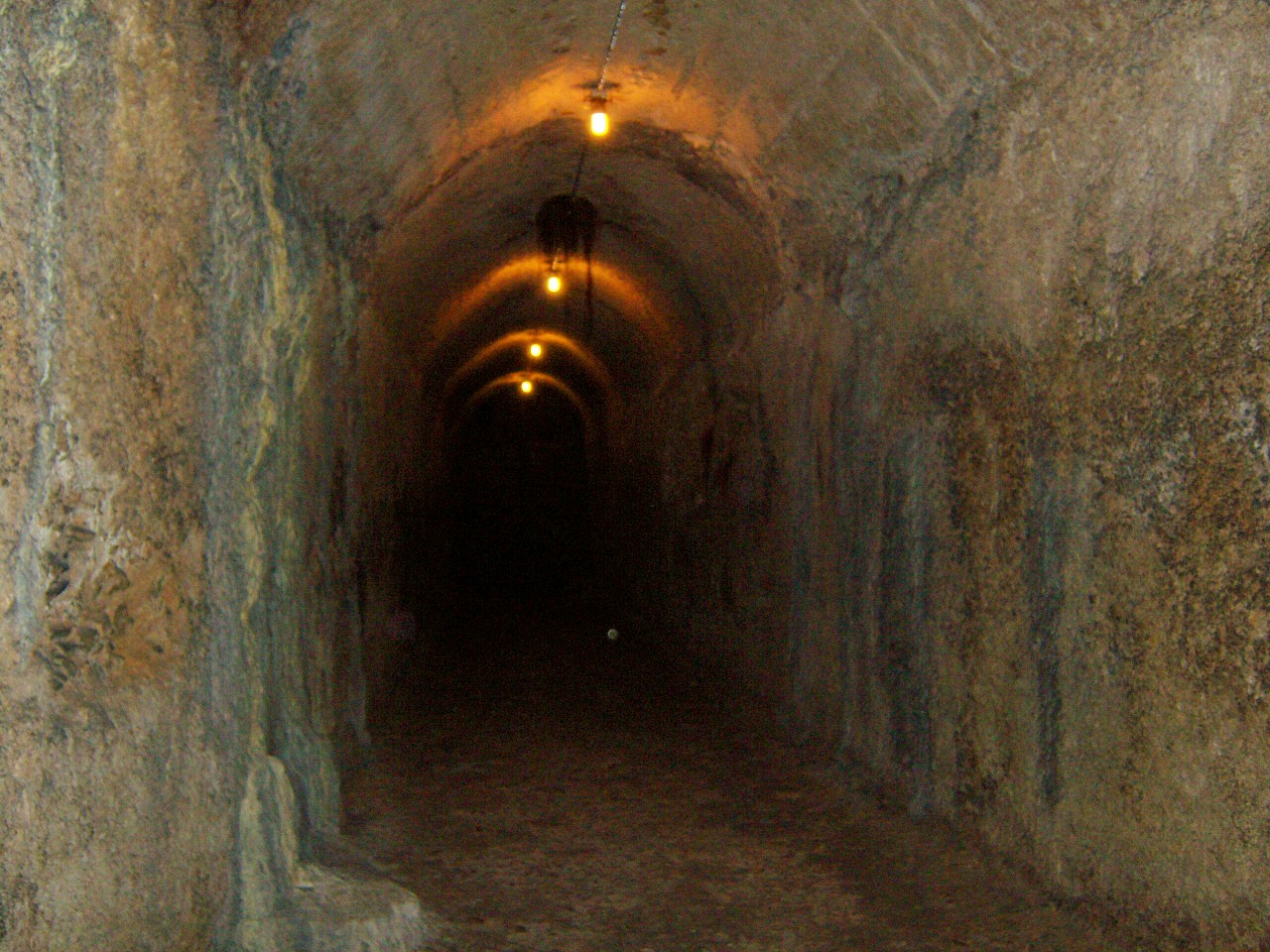
An underground cistern serves as a settling and buffering volume before filtration — particularly useful where iron concentrations are high and contact time for oxidation is needed. (Wikimedia Commons / CC)
Nitrate Reduction
Nitrate removal is more technically demanding than iron removal because nitrate is chemically stable and highly soluble. Three approaches are used in Czech residential installations:
Reverse Osmosis (RO)
Under-sink RO units with a 75–150 GPD membrane reduce nitrates by 85–95%. RO also removes most other dissolved contaminants, producing water meeting Vyhláška 252/2004 Sb. limits for all common parameters. The tradeoff is a reject stream of 3–4 volumes of water per volume of permeate, and membrane replacement every 2–3 years at approximately CZK 1,500–3,000. Suitable for drinking and cooking water only — treating full household flow is uneconomical.
Ion Exchange (Denitrification Resin)
Nitrate-selective anion exchange resins (type I or type II strong-base) selectively remove NO₃⁻ in preference to SO₄²⁻. A correctly sized column reduces nitrates from 80–100 mg/l to below 25 mg/l. Regeneration with NaCl brine produces a concentrated nitrate-salt waste stream requiring appropriate disposal — not into a septic system or stream. This method treats full household flow and is cost-competitive where nitrate is the sole concern.
Blending
Where a second water source (e.g., a deeper borehole or a nearby spring with low nitrate) is available, blending proportionally reduces the combined nitrate concentration. Simple and inexpensive but only applicable when a suitable second source exists.
UV Disinfection
When microbiological contamination is the primary concern — or as a precautionary final barrier after other treatment — ultraviolet disinfection inactivates bacteria, viruses, and protozoa without adding chemicals. UV units for residential use deliver a dose of ≥40 mJ/cm² at their rated flow rate, which meets WHO guidelines for drinking water disinfection.
Key installation requirements for effective UV performance:
- UV transmittance of the water must exceed 75% — iron, humic acids, and turbidity absorb UV and reduce dose. Always install UV downstream of any iron/manganese filter.
- Flow rate must not exceed the unit's rated capacity; oversized UV chambers provide longer contact time at the cost of higher capital expense.
- Lamp replacement every 9,000–12,000 operating hours (roughly 1–1.5 years of continuous use). Czech suppliers include Aqua-Pur, Atec, and Ivar.CS.
UV does not remove dissolved contaminants. It is a disinfection step, not a treatment barrier for chemical exceedances.
Water Softening
Czech water is generally hard — most private well water from limestone-rich areas runs 300–500 mg CaCO₃/l. At household scale, ion exchange water softeners replace Ca²⁺ and Mg²⁺ with Na⁺ through a cation resin bed. Regeneration uses tablet salt (NaCl), typically at 5–8 kg per regeneration cycle.
Softened water should not be used for drinking by people on sodium-restricted diets, and softening should bypass the kitchen cold-water tap to preserve mineral balance in drinking water. A Czech household with 4–6 members consuming 180–220 m³/year typically uses a 25–30 litre resin volume unit.
Combining Treatment Stages
Most Czech private wells with multiple parameter exceedances require a treatment train rather than a single unit. A common configuration for a well with high iron, elevated manganese, borderline nitrates, and periodic microbiological detections would be:
- Cascade aerator (iron oxidation, CO₂ removal, pH adjustment)
- Birm/sand filter (iron and manganese removal)
- Under-sink RO unit at the kitchen tap (nitrate and residual trace-element polishing)
- UV unit at the point of entry (microbiological barrier)
The total installed cost for this configuration, including pressure tank and automatic backwash controller, typically runs CZK 35,000–65,000 for a single-family house, depending on flow rate and component brand. Annual maintenance cost (salt, lamp replacement, media top-up) is approximately CZK 3,000–6,000.
Related: How to Drill a Residential Well — understanding the source before treating it. Managing Household Water Supply — pressure systems and seasonal supply management.
External reference: WHO — Drinking-water quality guidelines.