How to Drill a Residential Well in the Czech Republic
Drilling a private well is one of the more consequential decisions a Czech homeowner can make. The depth, casing material, and drilling method all affect long-term water quality and yield — and the process involves permits that most municipalities process in four to twelve weeks.
1. Site Assessment Before Anything Else
The starting point is a hydrogeological survey of the parcel. Czech Geological Survey (ČGS) maintains a publicly accessible database — HYDROEKOLOGICKÝ INFORMAČNÍ SYSTÉM (HEIS) — where existing borehole logs near your property are archived. Reviewing neighbouring well depths, yield records, and any documented contamination events in the catchment area takes an afternoon but prevents costly surprises.
Local factors that affect borehole placement include:
- Minimum separation distances: Czech legislation (Act No. 254/2001 Coll., Water Act) requires at least 10 m from a septic tank or cesspit, 15 m from a manure pile, and 50 m from a chemical storage area.
- Topographic position: mid-slope locations above known contamination sources outperform low-lying positions adjacent to agricultural fields.
- Fractured rock versus porous aquifer: granite-dominated western Bohemia typically yields water from fractures; Cretaceous sandstone zones in eastern Bohemia hold water in pore spaces, which allows wider yield predictions from published permeability data.
A qualified hydrogeologist issues a hydrogeological opinion (hydrogeologický posudek), which is required by most district water authorities before issuing a drilling permit. The fee for a basic posudek runs CZK 8,000–20,000 depending on the scope and whether a test pump is included.
2. Drilling Permit Requirements
Under the Czech Water Act (§ 8 and § 15), abstraction from groundwater for household use requires either a permit (povolení k nakládání s vodami) or, for small volumes under 6,000 m³ per year with a single household connection, a simpler notification (ohlášení). The relevant authority is the district water authority (vodoprávní úřad) at the local municipal office.
Required documents typically include:
- Application form for groundwater abstraction permit
- Hydrogeological opinion signed by a licensed hydrogeologist
- Cadastral map showing the planned borehole location
- Technical description of the intended drilling method and casing design
Processing time is 30–60 days for simple household applications. Construction of the borehole itself requires a separate construction permit (stavební povolení) from the building authority if the structure involves a pump house or concrete head works.
3. Drilling Methods Compared
Three methods are used for residential boreholes in the Czech Republic:
Rotary Drilling (Rotační vrtání)
The standard method for boreholes deeper than 20 m. A rotating drill bit — typically a tri-cone or PDC bit — advances through soft to medium-hard rock while drilling mud or water keeps the hole flushed. Diameters typically range from 150 mm to 300 mm for residential work. Penetration rates in Cretaceous sediments reach 5–15 m/hour; crystalline rock slows progress to 1–4 m/hour.
Cable Tool Drilling (Úderné vrtání)
An older method still used by smaller contractors for depths under 30 m in soft sedimentary formations. A heavy steel bit is repeatedly dropped and raised, crushing the material. Slower but less expensive to mobilise for shallow work.
Rotary Percussion (Kombinovaná metoda)
A rotary drill with a down-the-hole hammer — preferred in hard crystalline basement rock. The pneumatic hammer generates percussive energy at the bit face, reducing the torque required from the surface rig. Common in granite zones of the Bohemian Massif.
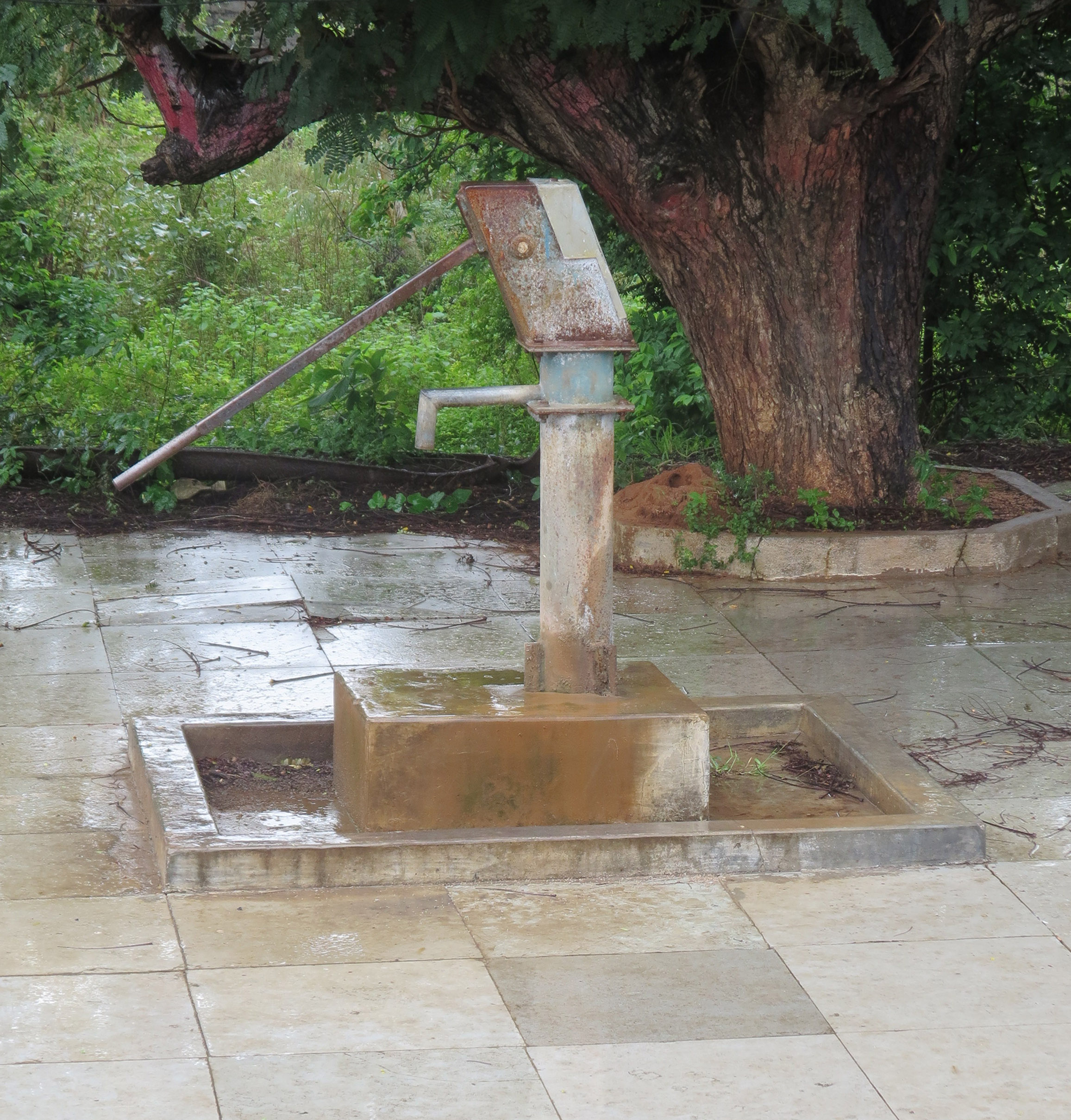
A hand pump provides non-electric access to the borehole — useful during power outages or as a backup for shallow dug wells. (Wikimedia Commons / CC)
4. Borehole Casing and Grouting
Casing prevents the borehole wall from collapsing and isolates the aquifer from surface contamination. Czech standard ČSN EN ISO 10426 covers casing material requirements. For residential boreholes, three casing materials dominate:
- PVC-U (rigid PVC): The most common choice for depths under 80 m. Lightweight, chemically inert, and straightforward to install. Screen slots of 0.3–0.5 mm are used in fine-grained aquifer zones.
- HDPE: Preferred in aggressive groundwater environments (high CO₂, low pH). More flexible than PVC and resistant to microbial fouling.
- Stainless steel 304 or 316: Used where sand or gravel content is abrasive, or where submersible pump vibration is significant. Higher cost but considerably longer service life.
Annular grouting — sealing the space between the casing and the borehole wall from surface down to at least 3 m below ground — is mandatory in Czech practice to prevent surface water from migrating down the annulus into the aquifer. Neat cement or bentonite-cement slurries are acceptable; bentonite pellets alone are not sufficient for the uppermost 3 m.
5. Development and First Yield Test
After casing and grouting, the borehole must be developed — that is, the drilling fluid and fine particles are removed from the formation adjacent to the screen. This is done by surging (alternating flow direction through the screen), air-lifting, or mechanical bailing. Adequate development reduces turbidity in the early pumping period from months to days.
A step-drawdown test (at three or more pumping rates over 6–8 hours) establishes the specific capacity of the borehole — typically expressed as m³/hour per metre of drawdown. For a single Czech household consuming 100–200 litres per person per day, a specific capacity above 0.5 m³/h/m is generally adequate. Results inform submersible pump selection.
6. First Water Quality Sample
Before connecting to household plumbing, a baseline water analysis is essential. The standard residential package for Czech private wells covers:
- Physical parameters: turbidity, colour, odour, conductivity, pH, temperature
- Inorganic parameters: nitrates (NO₃⁻), nitrites (NO₂⁻), ammonia (NH₄⁺), iron (Fe), manganese (Mn), arsenic, fluoride, hardness (Ca²⁺, Mg²⁺)
- Microbiological: E. coli, intestinal enterococci, total colony count at 22°C and 37°C
The Czech drinking water standard (Vyhláška č. 252/2004 Sb. in its current version) sets limit values for each parameter. Results determine whether treatment is needed before household use — and which treatment technology is appropriate.
7. Ongoing Maintenance
A private well requires periodic attention to remain reliable and safe. Key maintenance tasks include:
- Annual visual inspection of the wellhead, cap seal, and pump house for signs of surface water ingress
- Microbiological sampling every two years (more frequently in areas with intensive agriculture)
- Pump impeller wear check every 5–7 years, or when specific capacity drops noticeably
- Camera inspection of the casing every 10–15 years to detect corrosion or screen blockage
Well rehabilitation — using acid or polyphosphate treatments to dissolve mineral incrustation on the screen — extends the productive life of a casing that would otherwise require replacement. Czech drilling contractors typically offer rehabilitation as a half-day on-site service.
Further reading: Groundwater Treatment Methods — what to do once the analysis results arrive. Managing Household Water Supply — pressure systems, storage, and seasonal yield variation.
External reference: Czech Geological Survey (ČGS) — borehole database and hydrogeological maps.